
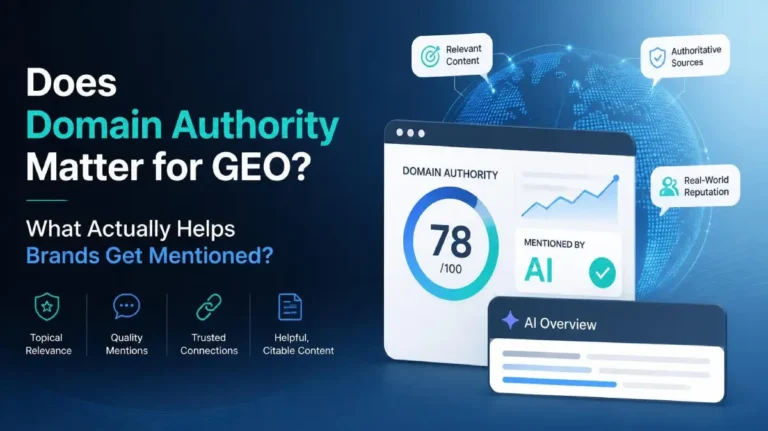




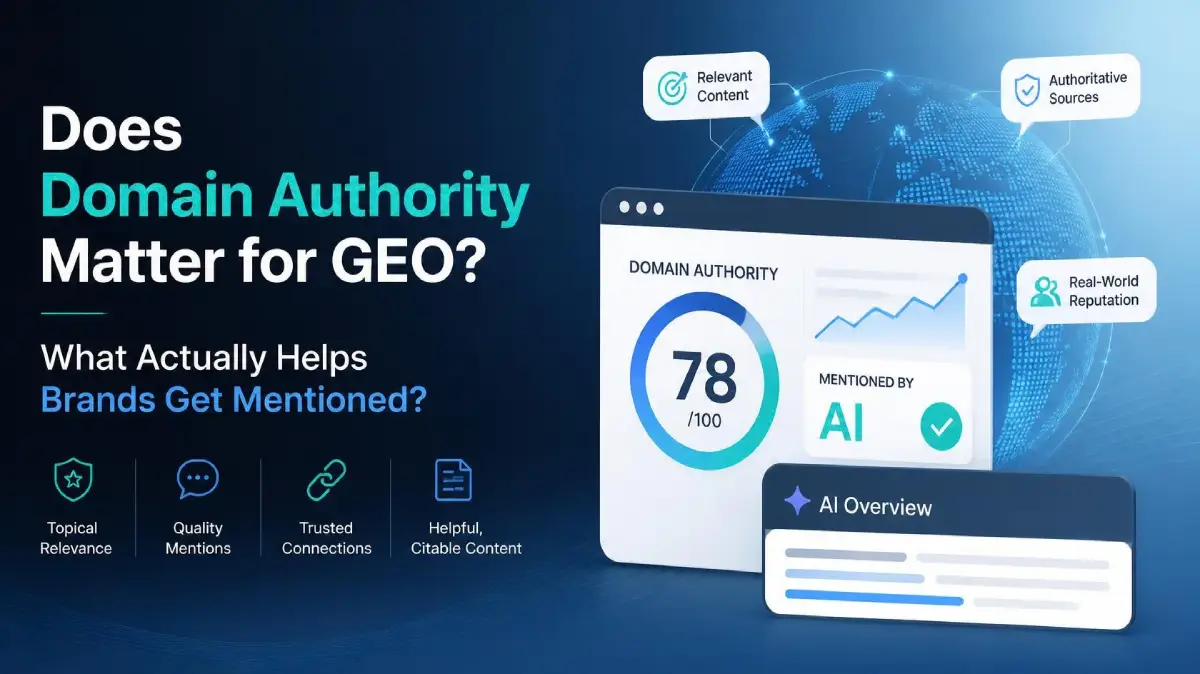
There was a time when Domain Authority felt like the number everyone wanted to talk about. A site with DA 60 looked strong. A site with DA 20 looked like it had some catching up to do.
This becomes pretty clear when looking at actual search results and AI answers side by side. A smaller site can sometimes get mentioned because it has a very useful page, a clear fact, or a source that fits the question unusually well. Meanwhile a large site with a strong backlink profile can be ignored.
That difference matters for Universal Link Media and for anyone working on Generative Engine Optimization.
What is Domain Authority and why do people still care about it?
Domain Authority or DA is a third party SEO metric created by Moz. It predicts how likely a domain may be to rank based mainly on its link profile. It is scored on a 100 point scale.
In GEO the bigger question is different. Can an AI system find the page, understand it, trust the information, and use it when forming an answer?
Does Domain Authority directly affect GEO visibility?
No. There is no public evidence that a specific DA score makes ChatGPT, Google AI Overviews, Perplexity, or other answer engines select a source.
DA is an SEO proxy. GEO is about visibility inside generated answers. Those two areas overlap but they are not the same thing.
A high authority domain may have advantages. It may have stronger editorial standards and more links pointing toward important pages. Those things can help.
Still, a lower DA website can have the better answer. If one page gives a clear explanation, includes useful facts, names the source, and answers the question quickly, it may be more useful than a bigger site with a vague page.
That is the part often missed in GEO discussions.
What signals matter more than DA for GEO?
There is no single public GEO scorecard. Still, several signals make practical sense based on how answer systems need to work.
- Clear answers. A page should answer the main question without making the reader dig through five paragraphs.
- Strong topical relevance. A page about one subject in detail is usually more useful than a page that briefly touches twenty subjects.
- Original information. Research, examples, first hand observations, customer data, surveys, and useful comparisons give an answer engine something concrete to work with.
- Trustworthy sources. Facts should be supported by reliable references when references are needed.
- Freshness. Pricing, product details, regulations, software features, and statistics can become stale quickly.
- Good page structure. Simple headings and direct sections make information easier to understand.
- Entity clarity. The company, product, author, place, and topic should be easy to identify.
- Mentions across the web. Independent references can help establish that a brand is real and relevant to a topic.
This is why GEO work can feel less like chasing one SEO number and more like making information easier to verify. A useful page does not need to shout that it is authoritative. It needs to show it.
Does link building still matter for GEO?
Yes, but probably in a less direct way than many people expect.
Links still help search engines discover pages and can support the authority and reputation of a domain. More importantly for GEO, quality mentions can create a wider trail of information around a brand.
The value is not just the links. When respected websites reference a company’s research or useful information, there is now a larger web of references connecting the company with that subject. That can make the brand and its expertise easier for search and answer systems to understand.
This does not mean buying hundreds of low quality links. In fact, that approach often feels like building noise.
The practical difference between SEO authority and GEO authority is worth looking at.
Signal | Traditional SEO value | Possible GEO value |
Relevant backlinks | High | Indirect but useful |
High DA | Useful comparison | Indirect only |
Original research | High | Very high |
Clear factual answers | High | Very high |
Brand mentions | Useful | Potentially strong |
Fresh information | Important | Very important |
Keyword repetition | Limited | Usually low value |
The interesting part is original research. A small company may not have a giant backlink profile. But if it publishes something nobody else has, that information can become a useful reference. That is a very different path to visibility.
Can a low DA website still appear in AI answers?
Yes. A low DA score does not automatically block a website from being cited or mentioned.
This happens because answer systems do not have to choose the biggest website every time. A niche page can be a better match for a specific question.
For example, someone searches for a very specific software setting. A small technical blog may have the clearest explanation. If the page is accessible and the information is useful, it can have a reason to appear even if its domain has a modest DA.
There is a lesson here for smaller brands. Chasing DA from 25 to 60 can take a lot of time. Publishing five genuinely useful pages may create more real value. That does not make links unimportant. It just puts them in their proper place.
What should a brand do if it wants better GEO visibility?
Start with the questions customers actually ask. Not just the questions that look good in a keyword tool.
Look at sales calls. Support messages. Comments. Product reviews. Reddit discussions. Search suggestions. Even the awkward questions people ask before buying can be useful. Then build pages that answer those questions plainly.
For each important topic, a simple content check can help:
- Answer the main question near the top.
- Add facts and dates where they matter.
- Explain terms in normal language.
- Include examples that show how the advice works.
- Link to original sources.
- Add a clear author or company identity.
- Update pages when the facts change.
- Earn relevant mentions from other sites.
It is also worth checking how a brand is described outside its own website. If one page says the company specializes in one thing while several independent sources describe it differently, there is a clarity problem. GEO is partly about consistency.
A practical scorecard for GEO work
There is no perfect measurement system yet. That is worth admitting.
A useful internal scorecard can still track the basics.
GEO area | Simple measure | Good sign |
Answer coverage | Questions answered | Important questions have direct answers |
Brand mentions | Relevant external mentions | Mentions grow in useful places |
Citations | AI answer citations | Brand pages appear as sources |
Freshness | Days since review | Important pages stay current |
Original value | Studies or unique data | New facts are being published |
Topic focus | Pages per core subject | Content is not scattered |
For Universal Link Media, this kind of tracking can reveal something DA cannot. A domain might stay at the same authority score for months while its useful mentions and AI visibility improve. That is not failure. It may actually be progress.
Why can DA still be worth watching?
So should DA be ignored? Not really. It can be useful when comparing websites for outreach. It can give a quick sense of link strength. It can also help spot obvious differences between competing domains.
The problem starts when DA becomes the finish line.A marketing team can spend weeks chasing links just to increase a metric by a few points. Meanwhile the website may still have thin pages, unclear service descriptions, weak evidence, and no original information.
That is backwards. A healthier approach is to treat DA like the dashboard light rather than the engine. It tells something. It does not tell everything.
The same goes for GEO. There is still plenty that is not fully visible from the outside. AI systems change. Search interfaces change. Citation behavior changes. What works today may look different six months from now.
That uncertainty is actually a good reason to focus on fundamentals.Clear information. Useful evidence. Real expertise. Relevant mentions. Fresh pages. A brand that is easy to understand.
Those things have a better chance of staying useful. Strong GEO work looks steady, useful, and less obsessed with scores than people often expect today.
The final take
Domain Authority matters for GEO only indirectly. A strong domain can have advantages because of its links, reputation, crawlability, and established presence. But DA itself is not a magic key to AI visibility.
The more useful question is not, “How do we get a higher DA?”
It is, “Why would an answer engine want to use this page?”
If the answer is because the page is clear, specific, current, well supported, and genuinely useful, the strategy is moving in the right direction.
And honestly, that feels like a better target anyway. Numbers are easy to chase. Useful information is harder to make. It is also much harder to fake.